03-并发设计模式
同步模式
保护性暂停
单任务版
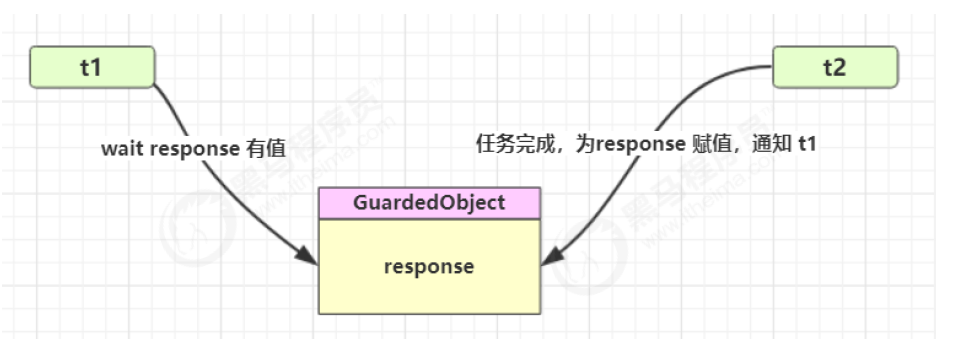
Guarded Suspension,用在一个线程等待另一个线程的执行结果
- 有一个结果需要从一个线程传递到另一个线程,让它们关联同一个 GuardedObject
- 如果有结果不断从一个线程到另一个线程那么可以使用消息队列(见生产者/消费者)
- JDK 中,join 的实现、Future 的实现,采用的就是此模式
public static void main(String[] args) {
    GuardedObject object = new GuardedObjectV2();
    new Thread(() -> {
        sleep(1);
        object.complete(Arrays.asList("a", "b", "c"));
    }).start();

    Object response = object.get(2500);
    if (response != null) {
        log.debug("get response: [{}] lines", ((List<String>) response).size());
    } else {
        log.debug("can't get response");
    }
}

class GuardedObject {
    private Object response;
    private final Object lock = new Object();

    //获取结果
    //timeout :最大等待时间
    public Object get(long millis) {
        synchronized (lock) {
            // 1) 记录最初时间
            long begin = System.currentTimeMillis();
            // 2) 已经经历的时间
            long timePassed = 0;
            while (response == null) {
                // 4) 假设 millis 是 1000,结果在 400 时唤醒了,那么还有 600 要等
                long waitTime = millis - timePassed;
                log.debug("waitTime: {}", waitTime);
                //经历时间超过最大等待时间退出循环
                if (waitTime <= 0) {
                    log.debug("break...");
                    break;
                }
                try {
                    lock.wait(waitTime);
                } catch (InterruptedException e) {
                    e.printStackTrace();
                }
                // 3) 如果提前被唤醒,这时已经经历的时间假设为 400
                timePassed = System.currentTimeMillis() - begin;
                log.debug("timePassed: {}, object is null {}",
                        timePassed, response == null);
            }
            return response;
        }
    }

    //产生结果
    public void complete(Object response) {
        synchronized (lock) {
            // 条件满足,通知等待线程
            this.response = response;
            log.debug("notify...");
            lock.notifyAll();
        }
    }
}
多任务版
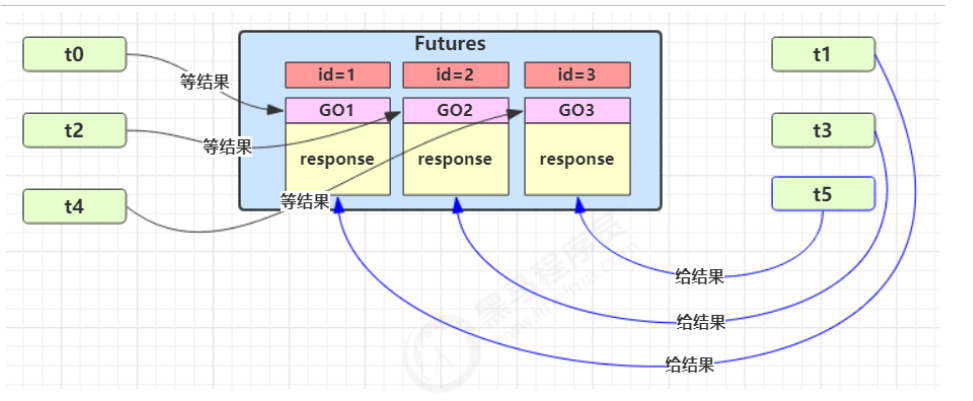
多任务版保护性暂停:
public static void main(String[] args) throws InterruptedException {
    for (int i = 0; i < 3; i++) {
        new People().start();
    }
    Thread.sleep(1000);
    for (Integer id : Mailboxes.getIds()) {
        new Postman(id, id + "号快递到了").start();
    }
}

@Slf4j(topic = "c.People")
class People extends Thread{
    @Override
    public void run() {
        // 收信
        GuardedObject guardedObject = Mailboxes.createGuardedObject();
        log.debug("开始收信i d:{}", guardedObject.getId());
        Object mail = guardedObject.get(5000);
        log.debug("收到信id:{},内容:{}", guardedObject.getId(),mail);
    }
}

class Postman extends Thread{
    private int id;
    private String mail;
    //构造方法
    @Override
    public void run() {
        GuardedObject guardedObject = Mailboxes.getGuardedObject(id);
        log.debug("开始送信i d:{},内容:{}", guardedObject.getId(),mail);
        guardedObject.complete(mail);
    }
}

class  Mailboxes {
    private static Map<Integer, GuardedObject> boxes = new Hashtable<>();
    private static int id = 1;

    //产生唯一的id
    private static synchronized int generateId() {
        return id++;
    }

    public static GuardedObject getGuardedObject(int id) {
        return boxes.remove(id);
    }

    public static GuardedObject createGuardedObject() {
        GuardedObject go = new GuardedObject(generateId());
        boxes.put(go.getId(), go);
        return go;
    }

    public static Set<Integer> getIds() {
        return boxes.keySet();
    }
}
class GuardedObject {
    //标识,Guarded Object
    private int id;//添加get set方法
}
顺序输出
顺序输出 2 1
public static void main(String[] args) throws InterruptedException {
    Thread t1 = new Thread(() -> {
        while (true) {
            //try { Thread.sleep(1000); } catch (InterruptedException e) { }
            // 当没有许可时,当前线程暂停运行;有许可时,用掉这个许可,当前线程恢复运行
            LockSupport.park();
            System.out.println("1");
        }
    });
    Thread t2 = new Thread(() -> {
        while (true) {
            System.out.println("2");
            // 给线程 t1 发放『许可』(多次连续调用 unpark 只会发放一个『许可』)
            LockSupport.unpark(t1);
            try { Thread.sleep(500); } catch (InterruptedException e) { }
        }
    });
    t1.start();
    t2.start();
}
交替输出
连续输出 5 次 abc
public class day2_14 {
    public static void main(String[] args) throws InterruptedException {
        AwaitSignal awaitSignal = new AwaitSignal(5);
        Condition a = awaitSignal.newCondition();
        Condition b = awaitSignal.newCondition();
        Condition c = awaitSignal.newCondition();
        new Thread(() -> {
            awaitSignal.print("a", a, b);
        }).start();
        new Thread(() -> {
            awaitSignal.print("b", b, c);
        }).start();
        new Thread(() -> {
            awaitSignal.print("c", c, a);
        }).start();

        Thread.sleep(1000);
        awaitSignal.lock();
        try {
            a.signal();
        } finally {
            awaitSignal.unlock();
        }
    }
}

class AwaitSignal extends ReentrantLock {
    private int loopNumber;

    public AwaitSignal(int loopNumber) {
        this.loopNumber = loopNumber;
    }
    //参数1:打印内容  参数二:条件变量  参数二:唤醒下一个
    public void print(String str, Condition condition, Condition next) {
        for (int i = 0; i < loopNumber; i++) {
            lock();
            try {
                condition.await();
                System.out.print(str);
                next.signal();
            } catch (InterruptedException e) {
                e.printStackTrace();
            } finally {
                unlock();
            }
        }
    }
}
异步模式
传统版
异步模式之生产者/消费者:
class ShareData {
    private int number = 0;
    private Lock lock = new ReentrantLock();
    private Condition condition = lock.newCondition();

    public void increment() throws Exception{
        // 同步代码块,加锁
        lock.lock();
        try {
            // 判断  防止虚假唤醒
            while(number != 0) {
                // 等待不能生产
                condition.await();
            }
            // 干活
            number++;
            System.out.println(Thread.currentThread().getName() + "\t " + number);
            // 通知 唤醒
            condition.signalAll();
        } catch (Exception e) {
            e.printStackTrace();
        } finally {
            lock.unlock();
        }
    }

    public void decrement() throws Exception{
        // 同步代码块,加锁
        lock.lock();
        try {
            // 判断 防止虚假唤醒
            while(number == 0) {
                // 等待不能消费
                condition.await();
            }
            // 干活
            number--;
            System.out.println(Thread.currentThread().getName() + "\t " + number);
            // 通知 唤醒
            condition.signalAll();
        } catch (Exception e) {
            e.printStackTrace();
        } finally {
            lock.unlock();
        }
    }
}

public class TraditionalProducerConsumer {
	public static void main(String[] args) {
        ShareData shareData = new ShareData();
        // t1线程,生产
        new Thread(() -> {
            for (int i = 0; i < 5; i++) {
            	shareData.increment();
            }
        }, "t1").start();

        // t2线程,消费
        new Thread(() -> {
            for (int i = 0; i < 5; i++) {
				shareData.decrement();
            }
        }, "t2").start();
    }
}
改进版
异步模式之生产者/消费者:
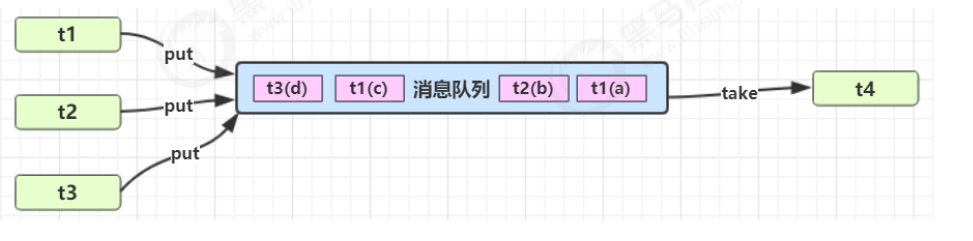
- 消费队列可以用来平衡生产和消费的线程资源,不需要产生结果和消费结果的线程一一对应
- 生产者仅负责产生结果数据,不关心数据该如何处理,而消费者专心处理结果数据
- 消息队列是有容量限制的,满时不会再加入数据,空时不会再消耗数据
- JDK 中各种阻塞队列,采用的就是这种模式
public class demo {
    public static void main(String[] args) {
        MessageQueue queue = new MessageQueue(2);
        for (int i = 0; i < 3; i++) {
            int id = i;
            new Thread(() -> {
                queue.put(new Message(id,"值"+id));
            }, "生产者" + i).start();
        }

        new Thread(() -> {
            while (true) {
                try {
                    Thread.sleep(1000);
                    Message message = queue.take();
                } catch (InterruptedException e) {
                    e.printStackTrace();
                }
            }
        },"消费者").start();
    }
}

//消息队列类,Java间线程之间通信
class MessageQueue {
    private LinkedList<Message> list = new LinkedList<>();//消息的队列集合
    private int capacity;//队列容量
    public MessageQueue(int capacity) {
        this.capacity = capacity;
    }

    //获取消息
    public Message take() {
        //检查队列是否为空
        synchronized (list) {
            while (list.isEmpty()) {
                try {
                    sout(Thread.currentThread().getName() + ":队列为空,消费者线程等待");
                    list.wait();
                } catch (InterruptedException e) {
                    e.printStackTrace();
                }
            }
            //从队列的头部获取消息返回
            Message message = list.removeFirst();
            sout(Thread.currentThread().getName() + ":已消费消息--" + message);
            list.notifyAll();
            return message;
        }
    }

    //存入消息
    public void put(Message message) {
        synchronized (list) {
            //检查队列是否满
            while (list.size() == capacity) {
                try {
                    sout(Thread.currentThread().getName()+":队列为已满,生产者线程等待");
                    list.wait();
                } catch (InterruptedException e) {
                    e.printStackTrace();
                }
            }
            //将消息加入队列尾部
            list.addLast(message);
            sout(Thread.currentThread().getName() + ":已生产消息--" + message);
            list.notifyAll();
        }
    }
}

final class Message {
    private int id;
    private Object value;
	//get set
}
阻塞队列
public static void main(String[] args) {
    ExecutorService consumer = Executors.newFixedThreadPool(1);
    ExecutorService producer = Executors.newFixedThreadPool(1);
    BlockingQueue<Integer> queue = new SynchronousQueue<>();
    producer.submit(() -> {
        try {
            System.out.println("生产...");
            Thread.sleep(1000);
            queue.put(10);
        } catch (InterruptedException e) {
            e.printStackTrace();
        }
    });
    consumer.submit(() -> {
        try {
            System.out.println("等待消费...");
            Integer result = queue.take();
            System.out.println("结果为:" + result);
        } catch (InterruptedException e) {
            e.printStackTrace();
        }
    });
}
设计模式
终止模式
终止模式之两阶段终止模式:停止标记用 volatile 是为了保证该变量在多个线程之间的可见性
class TwoPhaseTermination {
    // 监控线程
    private Thread monitor;
    // 停止标记
    private volatile boolean stop = false;;

    // 启动监控线程
    public void start() {
        monitor = new Thread(() -> {
            while (true) {
                Thread thread = Thread.currentThread();
                if (stop) {
                    System.out.println("后置处理");
                    break;
                }
                try {
                    Thread.sleep(1000);// 睡眠
                    System.out.println(thread.getName() + "执行监控记录");
                } catch (InterruptedException e) {
                   	System.out.println("被打断,退出睡眠");
                }
            }
        });
        monitor.start();
    }

    // 停止监控线程
    public void stop() {
        stop = true;
        monitor.interrupt();// 让线程尽快退出Timed Waiting
    }
}
// 测试
public static void main(String[] args) throws InterruptedException {
    TwoPhaseTermination tpt = new TwoPhaseTermination();
    tpt.start();
    Thread.sleep(3500);
    System.out.println("停止监控");
    tpt.stop();
}
Balking
Balking (犹豫)模式用在一个线程发现另一个线程或本线程已经做了某一件相同的事,那么本线程就无需再做了,直接结束返回
public class MonitorService {
    // 用来表示是否已经有线程已经在执行启动了
    private volatile boolean starting = false;
    public void start() {
        System.out.println("尝试启动监控线程...");
        synchronized (this) {
            if (starting) {
            	return;
            }
            starting = true;
        }
        // 真正启动监控线程...
    }
}
对比保护性暂停模式:保护性暂停模式用在一个线程等待另一个线程的执行结果,当条件不满足时线程等待
例子:希望 doInit() 方法仅被调用一次,下面的实现出现的问题:
- 当 t1 线程进入 init() 准备 doInit(),t2 线程进来,initialized 还为f alse,则 t2 就又初始化一次
- volatile 适合一个线程写,其他线程读的情况,这个代码需要加锁
public class TestVolatile {
    volatile boolean initialized = false;

    void init() {
        if (initialized) {
            return;
        }
    	doInit();
    	initialized = true;
    }
    private void doInit() {
    }
}